Abstract
Inference-time scaling for text-to-image generation has progressed from simple Best-of-N (BoN) sampling to guided search methods that verify and steer candidate trajectories at intermediate denoising steps. These approaches focus on when and how often to verify during denoising but largely treat the cost of generation itself as fixed. Moreover, the standard practice of comparing methods by number of function evaluations (NFEs) counts only denoising forward passes and ignores verifier overhead, which can distort efficiency rankings.
We show that under wall-clock evaluation, simple BoN already matches or outperforms several guided search techniques, suggesting that compute is better spent on broader exploration than on repeated intermediate verification. This motivates Flash-BoN, which generates a large pool of inexpensive draft candidates by combining three complementary acceleration knobs: timestep truncation, layer skipping, and activation proxies into a single configuration optimized once per model. An efficient multi-stage verification procedure then identifies the most promising draft, which is refined at full quality.
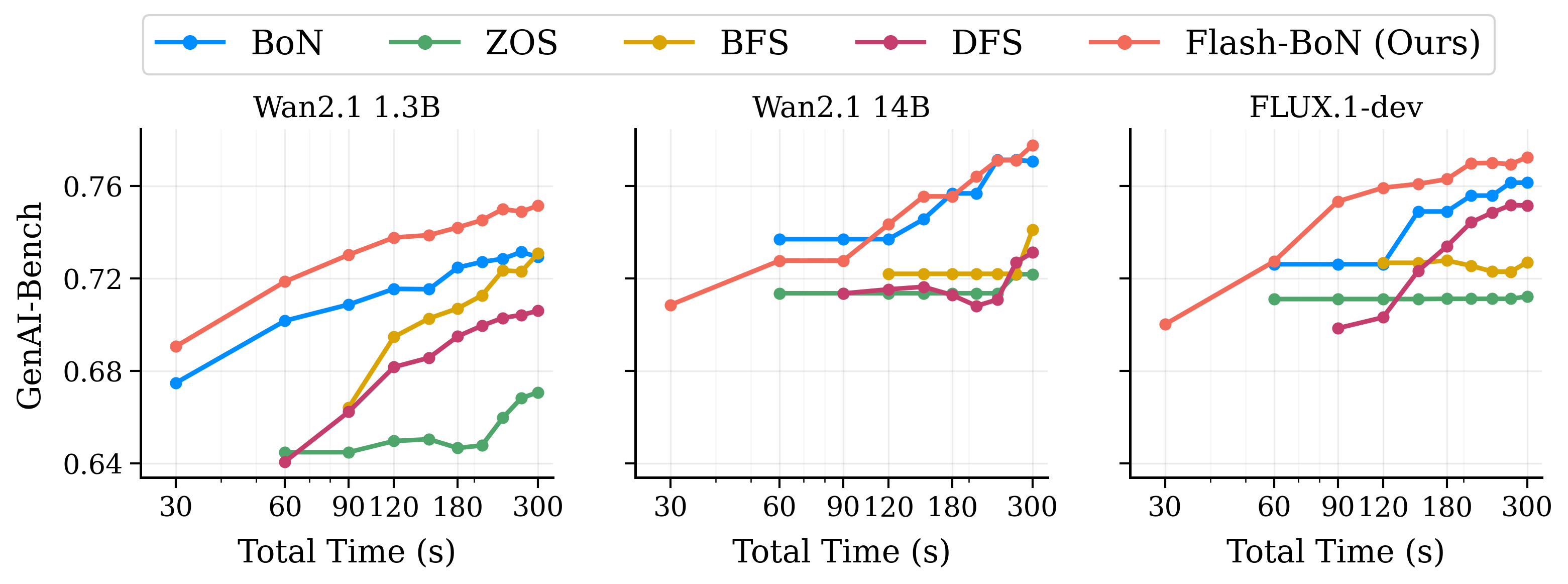
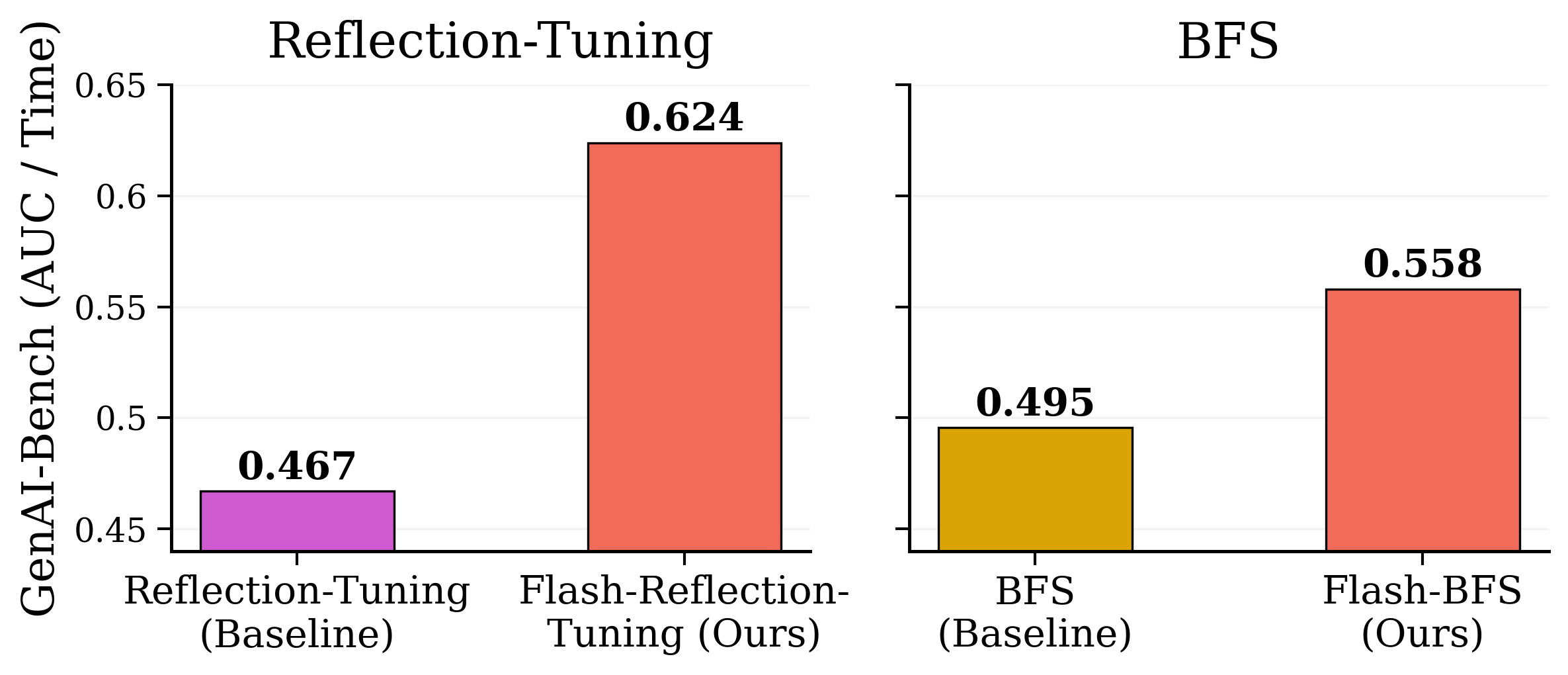
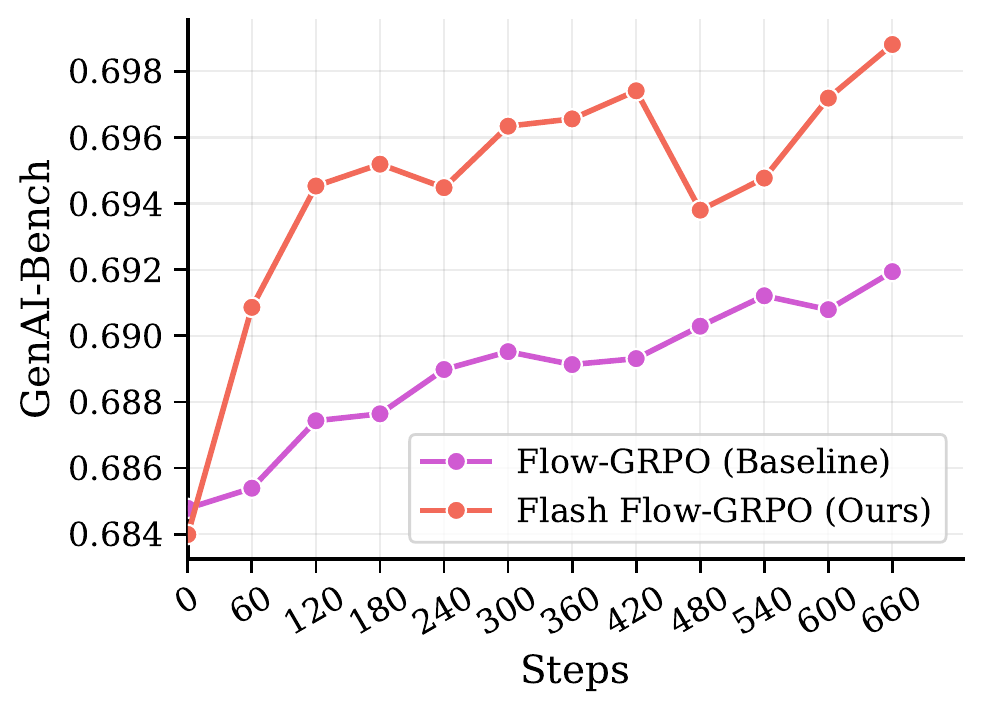
Across three benchmarks and three model scales, Flash-BoN consistently outperforms all baselines under fixed wall-clock budgets, with gains that grow at larger model scales (+8% AUC). We further show that our strategy combines well and improves existing orthogonal techniques such as reflection-based prompt optimization (+16% AUC). The gains correlate with increased candidate diversity, which also enables draft-guided selection to accelerate RL post-training convergence.
NFE vs. Wall-Clock: Rethinking Compute Accounting
Prior work typically compares inference-time scaling methods using the Number of Function Evaluations (NFEs) as a hardware-agnostic proxy. However, NFEs only count denoising forward passes and often ignore verifier costs entirely. This matters because methods that verify more frequently appear efficient under NFE accounting even when they are not under wall-clock time.
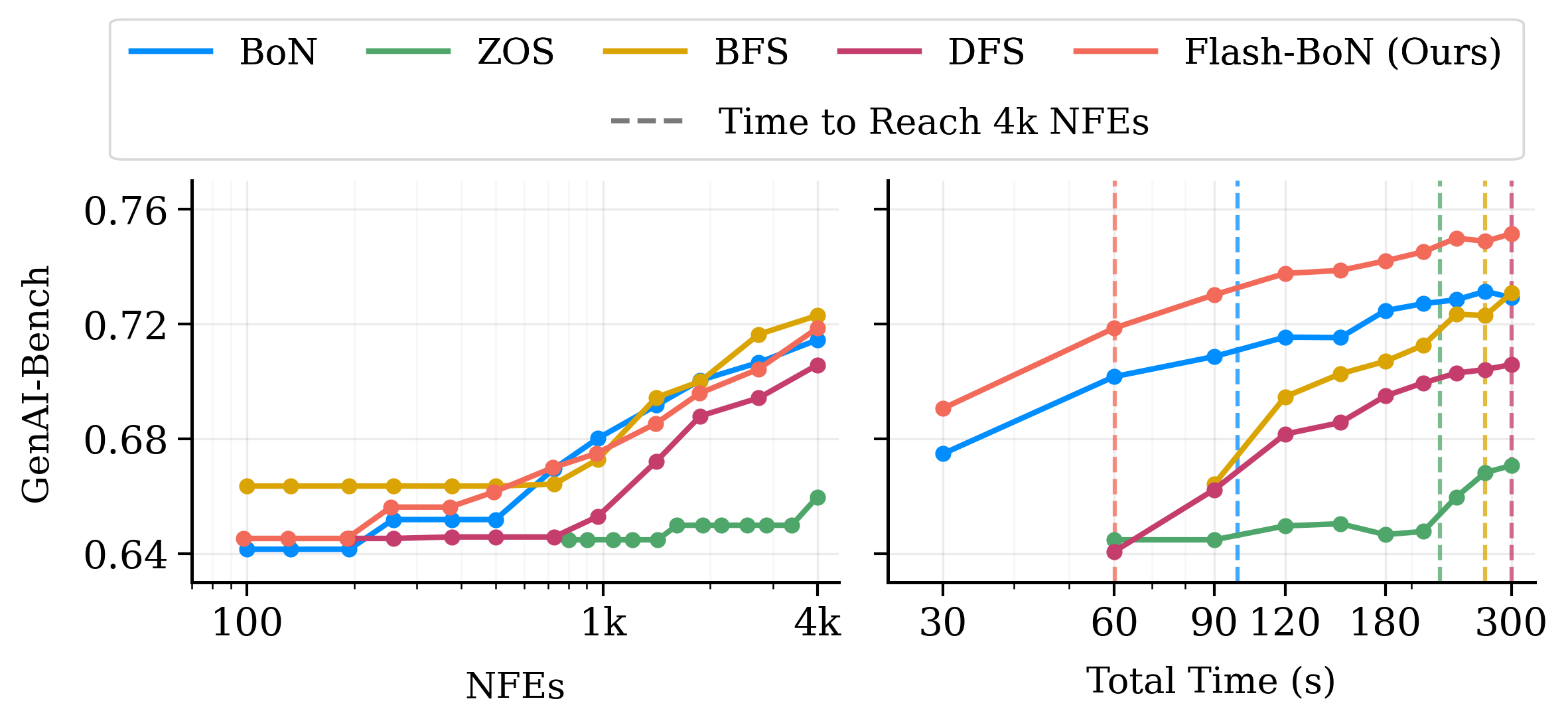
Once compute is adjusted to account for all costs (generation + verification), simple BoN already matches or exceeds guided search methods like BFS, DFS, and ZOS. This motivates our approach: rather than spending compute on repeated intermediate verification, we focus on generating more and cheaper candidates for broader exploration.
Flash-BoN Method
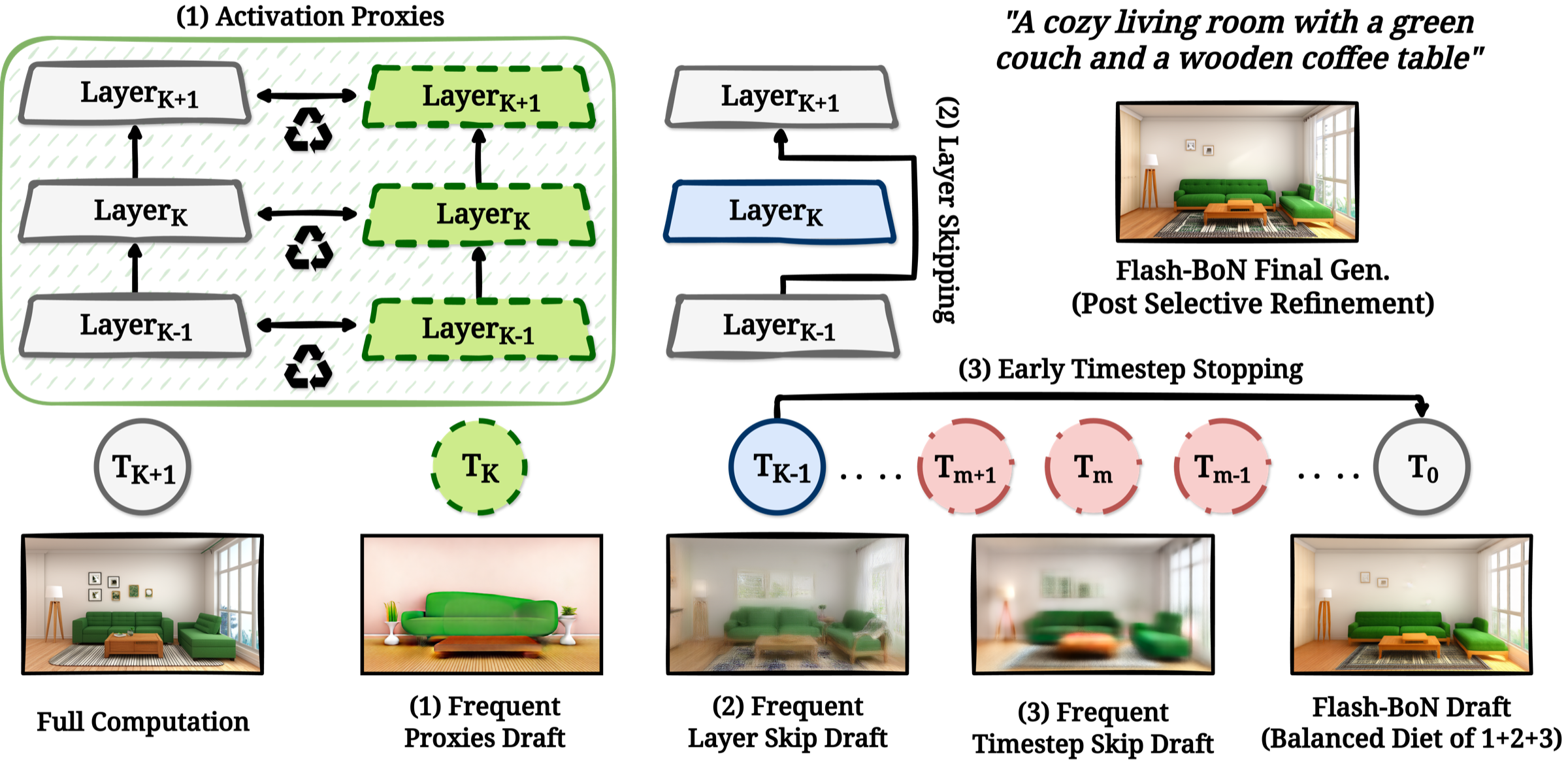
Flash-BoN builds on the observation that promising candidates can often be identified without full-cost generation. We define a draft configuration $\phi$ that combines three complementary acceleration knobs, then apply a multi-stage verification procedure to select and refine the best draft.
Three Acceleration Knobs
- Early Stopping. Truncate the denoising trajectory to $S'$ steps instead of the full $S$, producing rough but structurally informative previews
. - Activation Proxies. Exploit redundancy across timesteps by forecasting layer activations via a second-order Taylor expansion from cached features at previously visited timesteps
. - Layer Skipping. Selectively skip a subset of transformer layers $\mathcal{L}_{\text{skip}}$ during denoising, propagating the previous activation instead of computing the full block output
.
These three knobs define a joint configuration $\phi = (S', n_{\text{skip}}, \ell_{\text{start}}, \ell_{\text{end}}, f_{\text{full}})$. We formalize the search for the optimal draft configuration $\phi^*$ as a discrete optimization problem, solved once per model.
Multi-Stage Verification
Given $M$ draft candidates, pointwise scoring alone is unreliable: VLM-based verifiers
- Pointwise pruning + Elo seeding. Score all $M$ candidates, retain the top fraction, and initialize Elo ratings from pointwise scores.
- Sparse pairwise comparisons. Sort survivors by Elo, run adjacent head-to-head comparisons, and update ratings.
- Final selection. Return the candidate with the highest Elo rating for full-quality refinement.
Three-Stage Pipeline
- Stage 1 — Draft Generation: Generate $M$ cheap candidates $\{\tilde{y}_1, \ldots, \tilde{y}_M\}$ using $\phi^*$.
- Stage 2 — Verification: Score all drafts and select the most promising one via multi-stage Elo ranking.
- Stage 3 — Refinement: Regenerate the selected draft at full quality to produce the final output $y^*$.
Main Results
We evaluate Flash-BoN against four baselines — Best-of-N (BoN), Breadth-First Search (BFS),
Depth-First Search (DFS)
| Method | GenAI-Bench | GenEval | UniGenBench | ||||||
|---|---|---|---|---|---|---|---|---|---|
| Wan 1.3B | Wan 14B | FLUX | Wan 1.3B | Wan 14B | FLUX | Wan 1.3B | Wan 14B | FLUX | |
| ZOS | 0.52 | 0.57 | 0.57 | 0.29 | 0.36 | 0.37 | 0.45 | 0.52 | 0.49 |
| DFS | 0.55 | 0.50 | 0.51 | 0.36 | 0.37 | 0.35 | 0.47 | 0.46 | 0.45 |
| BFS | 0.50 | 0.43 | 0.44 | 0.31 | 0.28 | 0.29 | 0.43 | 0.39 | 0.38 |
| BoN | 0.65 | 0.60 | 0.60 | 0.43 | 0.42 | 0.42 | 0.54 | 0.53 | 0.54 |
| Flash-BoN (Ours) | 0.66 | 0.68 | 0.68 | 0.45 | 0.49 | 0.47 | 0.57 | 0.60 | 0.61 |
GenAI-Bench: Wall-Clock Comparison Across Scales
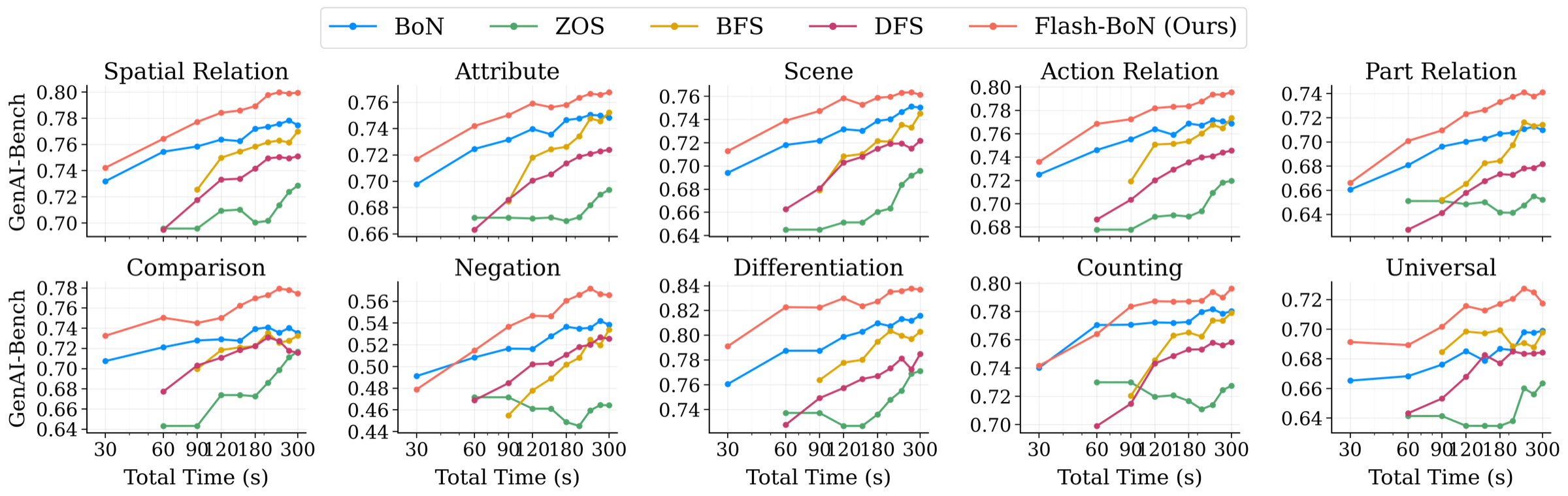
Per-Category Breakdown
Qualitative Comparison

Diversity Analysis
We measure candidate pool diversity using the Vendi Score
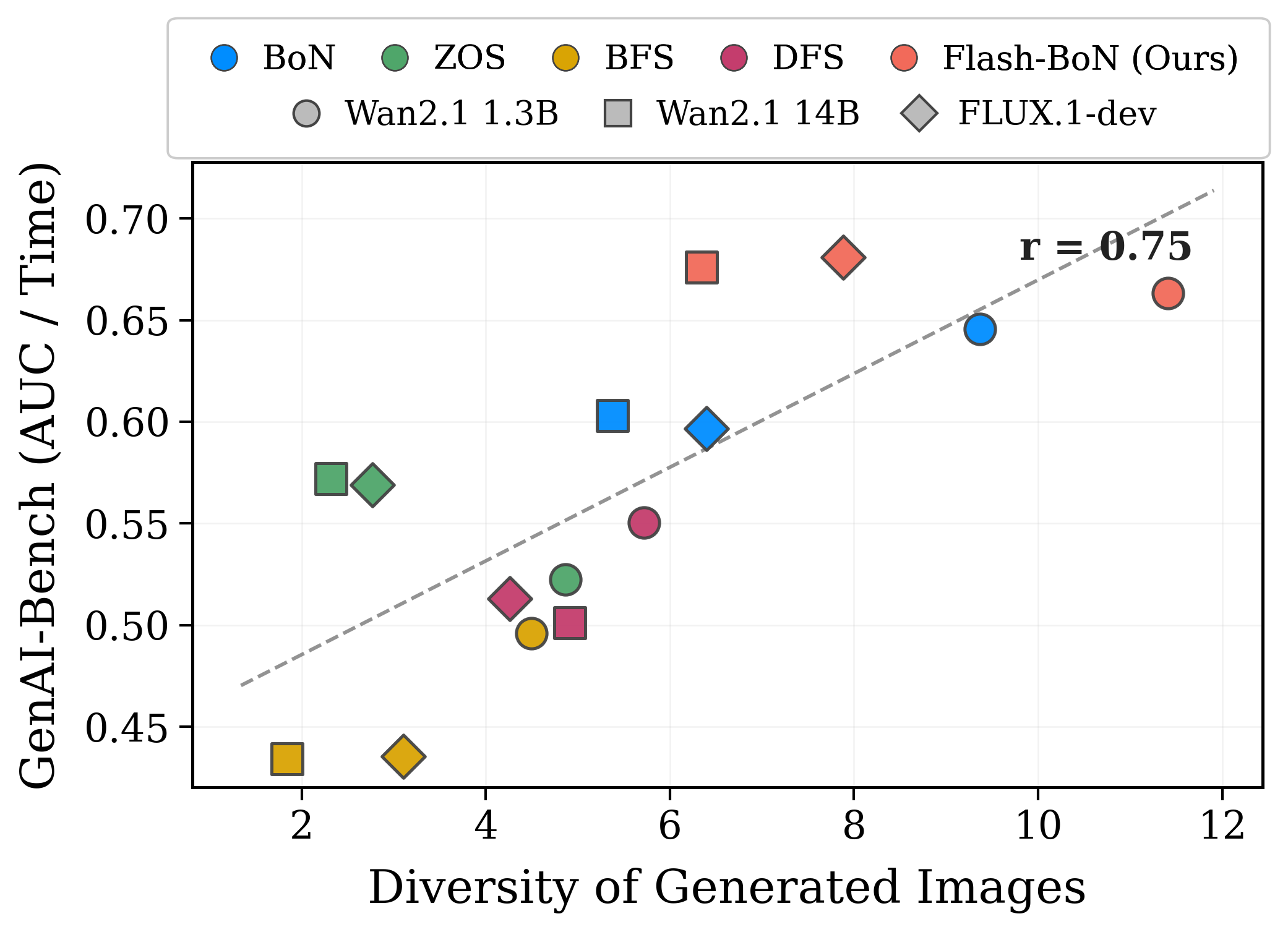
Combining with Orthogonal Techniques
The Flash draft strategy functions as a drop-in module that can be layered onto existing inference-time scaling methods.
Applying Flash drafts to Reflection-Tuning
RL Post-Training
The draft-guided selection principle transfers to reinforcement learning: Flash-Flow-GRPO matches baseline Flow-GRPO
Conclusion
We introduced Flash-BoN, a draft-and-refine inference-time scaling method that generates a large pool of inexpensive draft candidates by unifying three complementary acceleration strategies — timestep truncation, layer skipping, and activation proxies — into a single optimized configuration. Combined with a novel multi-stage verification procedure using Elo ranking, Flash-BoN consistently outperforms all baselines across three benchmarks and three model scales under fixed wall-clock budgets.
Key contributions include: (1) demonstrating that NFE-based comparisons distort method rankings by ignoring verifier costs; (2) a unified draft generation framework with a discrete optimization procedure; (3) consistent gains that grow at larger model scales (+8% AUC); (4) modular combination with orthogonal techniques like Reflection-Tuning (+16% AUC); and (5) accelerating RL post-training convergence by 10× via draft-guided selection.